| |
| Tuesday, 25 June 2024 |
| John Singer Sargent – A review of our recent Lecture June 13th 2024
|
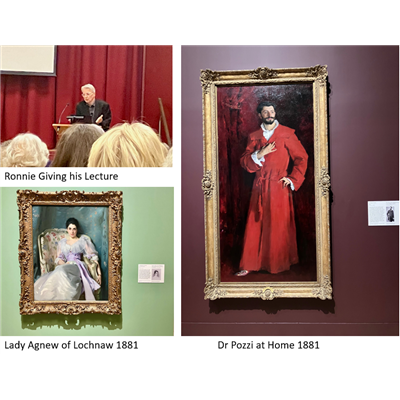 |
In June Ronnie Ireland told us all about the Society portrait painter of the late 19th century, John Singer Sargent, a prolific painter with over 3000 portraits. Was he an artist with a fabulous technique, painting inciteful character portraits or a flash Harry who sold out to people who had more money than sense?
Ronnie concentrated on showing us Singer Sargent’s technique and explained sight sizing whereby the easel would be set up next to sitter. In his later life , Sargent’s work became more mannered when he felt he had to go up against the grand manner portraitists, forcing his technique Ronnie pointed out that Sargent was technically good with good social skills who always got a good likeness and his images matched the sitters’ own social selves. He did emphasise though that his painting was tied to 19th century values but by the end of his life, what art might be and do had changed beyond recognition.
Jean Aarons |
|
| Tuesday, 25 June 2024 |
| Expressionists: Kandinsky, Münter and The Blue Rider - at Tate Modern to 20.10.24 |
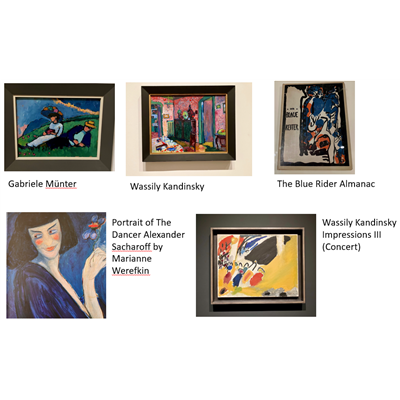 |
https://www.tate.org.uk/whats-on/tate-modern/expressionists This splendid exhibition, organised by Tate Modern in collaboration with Lenbachhaus in Munich is well worth visiting.
The Exhibition features principally works by Wassily Kandinsky and his partner, Gabriele Münter and their friends Marianne Werefkin and Alexej Jawlensky. These artists had broken away from the more conventional academies of fine art to form the Munich based group Neue Künstervereinigung München( NKVM) in 1909. There are also works on show by other artists from Eastern and Western Europe and USA who joined them later such as Wladimir Burljuk, Erma Bossi, Elisabeth Epstein, Franz Marc Paul Klee, Robert Delaunay and August Macke. They took on the name the Blue Rider Group (Der Blaue Reiter) in 1912 and held two experimental exhibitions and established a journal, The Blue Rider Almanac.
It is the power of colour which strikes one most about the exuberant, vibrant paintings displayed. One also notices the bold outlines and large areas of single rich colours. This colour is not used descriptively but more to express a mood.
As well as the stunning paintings, there is a section explaining the colour theories of Johann Wolfgang Von Goethe and Michel-Eugène Chevreul. A display of achromatic doublet prisms shows how Franz Marc separated the colours in his Deer in the Snow II painting.
Link to Deer in the Snow II https://www.wikiart.org/en/franz-marc/deer-in-the-snow-1911 Kandinsky explored the connections to musical works of e.g. Arnold Schönberg. The group was heavily involved too with dance and theatre and the dancer Alexander Sacharoff whose portrait features strongly at the Exhibition, was part of the group. The influence of Japanese prints and folk art is much in evidence. There are also examples of techniques like reverse glass painting.
Sadly with the onset of World War I the group dispersed. Some members were killed in combat and others went into exile in Switzerland.
Jean Aarons |
|
| Thursday, 03 August 2023 |
| JOHANNES VERMEER |
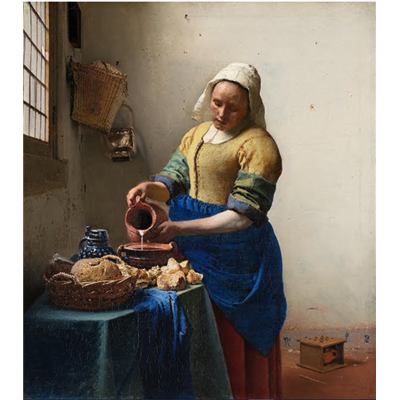 |
Tickets were hard to come by for the Vermeer Exhibition at the Rijksmuseum in Amsterdam earlier this year. However, members of Arts Society Croydon Area had the opportunity to feast their eyes on these wonderful paintings via Exhibition on Screen’s film Vermeer: The Greatest Exhibition which had several showings at the David Lean Cinema in the Clocktower, Central Croydon https://davidleancinema.org Arts Society Croydon Area is planning its own talk about Vermeer’s work on 14th March, 2024 at All Saints Church Hall in Sanderstead CR2 9AB when Dr Peter Ross will present a lecture entitled Vermeer’s Milkmaid : A Painting Revealed
https://tascroydonarea.org.uk |
|
| Saturday, 03 June 2023 |
| Mary Cassatt - Painting the Modern Woman - A review |
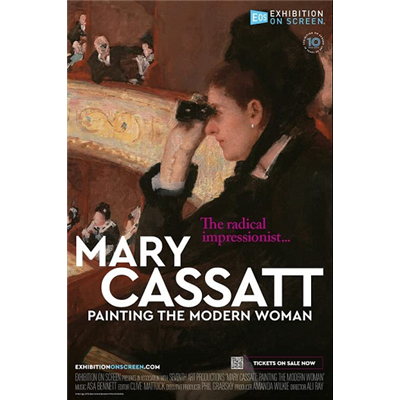 |
Inspired by Sarah Burles’ enjoyable April talk at Arts Society Croydon Area, Les Trois Grandes Dames of Impressionism, a group of us went to the David Lean Cinema in Croydon on May 30th to see the film Mary Cassatt - Painting the Modern Woman. As a result we learned a lot more about this very interesting American artist from Pittsburgh, Pennsylvania who spent much of her life in France and who lived from 1844 until 1926.
Sarah Burles had emphasised her importance within the Impressionist Movement and Mary Cassatt exhibited at four of the Impressionists’ Exhibitions in 1879,1880,1881 and 1886. However she had a range which far exceeded the scope of Impressionism. She was a very talented artist who received some formal art training in America but, as Sarah explained in her lecture, this training was restricted due to the constraints placed upon women students at the time. However, when she came to France she learned much more by visiting the Louvre and taking private lessons with the leading academic painter, Jean- Léon Gérôme and working with other artists such as Édouard Frère and Paul Soyer during stays in Courance and Écouen.
The film emphasised how interested she was in the work of other great artists, which she drew on to improve her own painting. She went to Parma in Italy where she was inspired by the work of Correggio and Parmigianino. She also visited Spain, Belgium, Holland, and saw the paintings of Velasquez,Rubens and Hals. In 1868, her painting A Mandolin Player was the first of her works to be accepted by the Salon.
A huge influence was Edgar Degas who was a lifelong friend and through him she met other great avant-garde painters like Manet and Renoir and was inspired by their ideas on technique and use of colour and light.
Cassatt’s key paintings such as The Tea and Little Girl in a Blue Armchair and In the Loge were comprehensively discussed. Later she made a speciality of the Mother and Child theme, a fact that was lavishly illustrated and explained in the film. In these later paintings her use of white was of particular interest, as was her fascination with painting hands.
We all admired the exquisite prints she produced as a result of the inspiration of Japanese printmakers like Hiroshige and Hokusai whose work was introduced to the Western World in the late 19th century.
As well as showing and discussing Cassatt’s work in great detail, this film was hugely informative about the history of art, explaining, for example, how revolutionary Impressionism was in comparison with the formal classical traditions favoured at the time by the Salon. Some of the processes of picture making were shown and we were treated to demonstrations of the techniques of etching and printmaking too.
Mary was involved in the Women’s movement and produced a mural about Modern Woman for the Women’s Building of the World’s Colombian Exposition in 1893.
The film also outlined Mary Cassatt’s rôle as adviser to art collectors like Mr and Mrs H.O. Havermeyor who she accompanied on an art buying trip in 1901. Most of the Havermeyor collection is now in the Metropolitan Museum in New York.
France awarded her the Légion d’Honneur in 1904. Sadly in her later life, Cassatt began to lose her sight and had to stop painting in 1914. She died in 1926 in her country home in France at Château de Beaufresne near Paris.
Jean Aarons June 2023 https://tascroydonarea.org.uk https://www.davidleancinema.org.uk Later this month on June 22 2.30 & 7.30pm David Lean Cinema are screening Vermeer: The Greatest Exhibition.
Arts Society Croydon Area have a lecture on March 14 Vermeer’s Milkmaid, A Painting Revealed - Peter Ross http://youtu.be/LHDSYU2tjRo Mary Cassatt: Painting the Modern Woman review – fine portrait of a neglected artist https://www.theguardian.com/film/2023/mar/07/mary-cassatt-painting-the-modern-woman-review-fine-portrait-of-a-neglected-artist?CMP=Share_iOSApp_Other Article https://artsandculture.google.com/asset/in-the-loge-supplemental/tgF6xIFz0Qjp1w?childAssetId=ZQGKtZwoK24JPQ In the Loge - Mary Stevenson Cassatt - Google Arts & Culture |
|
| Thursday, 18 May 2023 |
| Historic Landmarks of the North East - A review |
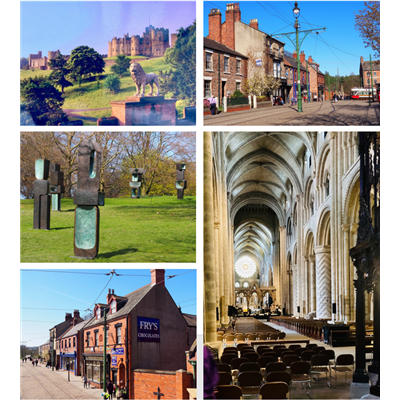 |
The pandemic close down led to the loss of the habit of going on outings. This meant that it took some courage and persistence to encourage sixteen members of the Croydon Art Society to travel north well over three hundred miles to the Beamish Valley to view the "Historic Landmarks of the North East".
On Tuesday 18th April as the bell of the old Sanderstead Church tolled the early hour of 8am,we set off driven expertly by our young lady driver.
On our way we visited the Yorkshire Sculpture Park, with work, scattered over a very wide area by Moore, Hepworth, Gormley and many others. The long drive to the 18th century hotel meant a late dinner in the "Stables". The food throughout was good and very plentiful (later some shared and others enjoyed the children's menu which came with crayons to colour in the pictures). The service was terrible but the long wait did mean that we all got to know each other.
The next morning, we travelled with our knowledgeable and enthusiastic guide to Newcastle, breaking our journey to see up close "the Angel of the North”, a huge imposing work of art but certainly in profile, strangely human and comforting. Newcastle is a fine city, its devastated industrial centre rebuilt imaginatively as an arts and education centre under the leadership of the disgraced T Dan Smith, the last of its seven bridges an initially controversial structure capable of being tilted to allow the passage of ships, a wonder and tourist attraction. The tour was largely by coach which kept the group together, enabled us to see more of the city centre and hear the guide and keep out of the cold wind.
In the afternoon we returned to Beamish to visit the world-famous open-air museum that brings the region's history to life where you can explore the exhibit areas, including the Edwardian Town, Colliery Village, Home Farm, Peverley Manor and the Railway Station, recreations of life in the North East in the early 1900s.The attractions are linked by old trams and buses and enhanced by the staff wearing clothes of the period.
The following day we travelled to Alnwick Castle, seat of the Duke of Northumberland, home of the Percy’s since 1309 with paintings by Titian, Van Dyck, and Canaletto which we had too little time to view and large numbers of pistols and swords procured for the duke’s private army arranged decoratively. The highlight of the visit was the afternoon tour of the beautiful gardens designed by the Duchess, with the spectacular water feature the poison garden, and with the weather fine and warm, the magnificent display of cherry blossom with comfortable swings hung from the many trees.
The fourth day of our visit was a walking tour of Durham ending at the Cathedral the focal point of the city, the resting place under a plain marble slab behind the high altar of St Cuthbert of Lindisfarne to whom the City owes its existence. The Cathedral is host to all sorts of events. The writer had once seen a wonderful performance of the Messiah, but the previous day there had been a tribute to Elvis! In the afternoon we visited the purpose-built French style chateau, The Bowes Museum, housing the largest collection of French paintings in the country together with textiles ,ceramics and fine furniture brought together by the sadly childless John and Josephine Bowes.
Our final day continued cold and wet as it had been the previous evening, but improving as we broke our journey to see Hardwick Hall after a long hazardous coach trip through narrow lanes occasioned by road closures. Bess of Hardwick second only to Elizabeth the First in wealth's motto was said to be, marry young, marry rich, and marry often. The House contains contemporary furniture, tapestries and needlework including pieces going back to 1601.
Thanks to our leader a very enjoyable trip in good company, the facilities at the places visited clean and adequate, the staff welcoming and knowledgeable. Douglas Oliver |
|
| Saturday, 22 April 2023 |
| TASCA Historic Landmarks of the North East
Tuesday to Saturday, 18 to 22 April 2023
|
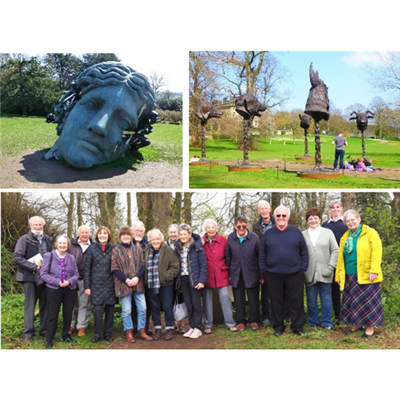 |
Sixteen of us set off at 08:00 on Tuesday morning, heading north for our first landmark, the Yorkshire Sculpture Park. Set in 500 acres of 18th century parkland belonging to the Bretton Estate, this open-air gallery is home to sculptures by eminent artists from around the world, including Henry Moore, Antony Gormley, James Turrell, Barbara Hepworth and Andy Goldsworthy. Although we were provided with a map, a couple of us thought that more signage would have helped. When I got home I realised that while I had concentrated on pinpointing my location, I missed the fact that the sculptures were listed and given a grid reference. I did, however, see the Ai WeiWei Circle of Animals/Zodiac Heads (left), Barbara Hepworth and Henry Moore, plus lots more. We then made our way to the Beamish Hall Hotel, our home for the next four nights. There was a slight problem in getting food to 17 of us in good time, and it was almost 21:30 before our main course arrived. At breakfast the next morning, it was agreed that we would place our food orders the previous day. The food was good with interesting Asian flavours, but the portions were enormous. One member asked to see the children’s menu, which was highly decorated, and the waitress cheekily asked if he would also like crayons! By the end of the week several members were choosing from this menu. On Wednesday we were joined by an excellent Blue Badge Guide, Jan Williams, who accompanied us on a tour of Newcastle city centre. We saw the elegant streets of Grainger Town, the Grade 1 listed Theatre Royal, the Great North Children’s Hospital, the Centre for Life (a science village where scientists, clinicians, educationalists and business people work to promote the advancement of the life sciences) and, of course, Newcastle United Football Ground. We ended our tour at the Gateshead Millennium Bridge, near the Baltic Gallery. Within a quarter of a mile, there are seven bridges crossing the Tyne. Here are just three of them. In the afternoon we made our way to the Beamish Museum. Established by curator Frank Atkinson in 1972 to celebrate North East England’s industrial heritage, including coal mining, ship building and steel manufacturing, and the communities that served them. This world-famous open-air museum boasts an Edwardian Town, Colliery Village, Home Farm, Pockerley Manor and Railway Station, all recreations of life during the 1900s. To get around this vast site, one can hop on and off original trams and double-decker buses. Thursday, was spent at Alnwick Castle with a guided tour of the state rooms in the morning, followed in the afternoon by a guided tour of the gardens designed by the Duchess of Northumberland. Jan Williams joined us again on Friday for a guided tour of Durham, and Durham Cathedral which owes its existence to St Cuthbert of Lindisfarne. We travelled on to Barnard Castle in the afternoon to The Bowes Museum, a French-style chateau, purpose built by John and Josephine Bowes who indulged their passion for the arts, culminating in an extensive collection of French paintings, as well as textiles, ceramics, and fine furniture. We had been very lucky with the weather all week but on Saturday morning, the last day of our tour, we were greeted with heavy rain. Fortunately, as we drove further south the weather gradually improved and when we reached Hardwick Hall the sun was shining. A National Trust property, Hardwick Hall is a late 16th century ‘prodigy house’ designed by Robert Smythson for Bess of Hardwick. It contains contemporary furniture, tapestries, and needlework, including pieces identified in an inventory of 1601. We arrived back in Croydon at 20:00 on Saturday evening. I found it a fascinating tour, albeit somewhat tiring as there was a lot of walking involved, and I’m sure that each of us has our own highlights. Our coach was driven by Alison, she was an excellent driver and good company at dinner. Finally, our thanks go to Joe and Evi for organising this holiday. Patricia Painting The photographs were taken by Patricia Painting. |
|
| Saturday, 22 April 2023 |
| A Review : Les Trois Grandes Dames of Impressionism
13th April 2023
|
 |
We were treated to a wonderful talk by Sarah Burles on Thursday 13th April about the three female Impressionist painters, Berthe Morisot, Mary Cassatt and Marie Bracquemond, defined as “Les Grandes Dames de l’Impressionisme" by the art critic and journalist Gustave Geffroy. All three exhibited at the Impressionist Exhibitions in Paris which ran from 1874-1886.
At the time, as in other fields, it was difficult for a woman to become a successful artist. Women were often defined by their relationships with men and had limited opportunities They faced numerous challenges and obstacles in furthering their craft. For example, the École des Beaux Arts in Paris did not admit women until 1897. A big stumbling block was demonstrating you could draw a nude. Women had to practise drawing their nudes from casts and were only allowed to copy from a nude directly when the Académie Julien allowed this in 1889.
There were restrictions on the subject matter a woman could paint - women of a certain class were chaperoned and could not go out and about like, for example, Auguste Renoir to paint pictures like "Bal du Moulin de la Galette" or "Luncheon of the Boating Party" or frequent the nightspots depicted by Manet in "Bar aux Folies-Bergère." Their subjects were more domestic and family orientated such as the exquisite "The Cradle” 1872 by Berthe Morisot depicting her sister Esma with her baby
https://www-musee--orsay-fr.translate.goog/en/artworks/le-berceau-1132?_x_tr_sl=fr&_x_tr_tl=en&_x_tr_hl=en&_x_tr_pto=sc Women were expected to be obedient wives and mothers. Their work was judged in feminine terms and was defined by their ability to paint so called female subjects such as domestic scenes and pictures of mothers and children.
First of all, Sarah Burles considered the work of Marie Bracquemond (1840 - 1916) least well known of the three. An accomplished artist, she was a pupil of Jean-Auguste-Dominique Ingres and had exhibited at the Paris Salon too prior to showing her work in the Impressionist Exhibitions of 1879, 1880 and 1886. She enjoyed painting en plein air and pursued ardent illusions of colour, particularly after she met Paul Gauguin who knew her husband, Félix, an art critic. However Félix was a very domineering man who preferred more formal studio portraits and did not encourage her so she eventually gave up.
Among the paintings illustrating Bracquemond’s work, Sarah showed us "Under the Lamp" depicting Alfred Sisley and his future wife and a work painted in her garden in Sèvres of her son "Pierre and his aunt Louise”. Much of Marie Bracquemond’s work is in the hands of private collectors.
Sarah considered Berthe Morisot (1841-1895) next. She came from a wealthy family and received painting lessons with her sister. She was a pupil of Jean-Baptiste-Camille Corot and was influenced by the Barbizan group. She met Édouard Manet at the Louvre which was a meeting of the minds and Berthe was alive to what Manet, Claude Monet and the other Impressionists were trying to achieve. As a result, her painting became looser, less “finished” and more spontaneous. She was invited to exhibit at the first Impressionist Exhibition in 1874 which was high risk because her work was getting to be accepted in conventional circles and she had displayed work at the Salon. She went on to exhibit at all but one of the Impressionist Exhibitions.
Following her marriage to Manet’s brother Eugène, she gave birth to their daughter Julie, who often featured in her paintings - Julie was said to be “growing up under her mother’s paintbrush."
Morisot’s later work was more expressionistic and colourful. She became interested in the work of Georges Seurat and Paul Signac and embraced the current ideas about colour theory. She died in 1895 aged just 54 leaving a legacy of 423 paintings. Many of these can be seen at the Musée Marmottan in Paris and some are currently on display at the Dulwich Picture Gallery’s Exhibition Berthe Morisot : Shaping Impressionism
https://www.marmottan.fr/en/collections/berthe-morisot/
Mary Cassatt 1844 - 1926 was American from a well off family and received some formal art training. Although she had exhibited at the Salon in earlier years (The Mandolin Player 1868),her work was rejected by them in 1877. She was a great friend of Edgar Degas who, following this rejection, urged her never to submit to the Salon again. She exhibited for the first time at the Fourth Impressionist Exhibition in 1879 and then at the Exhibitions of 1880, 1881 and 1886.
She was very interested in colour and interiors as well as the Spanish and Dutch Golden Age. Her work is very striking and sometimes controversial. Among the notable Cassatt works presented was "Reading Le Figaro"1878 where she portrays her mother reading a newspaper. The painting is notable for its use of white and the fact that women were not meant to read the papers! The very blue "Little Girl in a blue armchair 1878" with its visible brushwork and awkward pose reflects the Impressionist influence whereas the cropping shows the influence of Japanese prints. "In the Loge"1878 shows a woman looking out using her opera glasses - she is not there to be seen despite the fact that we can see someone in the background looking at her.
Mary Cassatt was a wonderful printmaker too. A staunch feminist she completed a mural for the Women’s Building at the Worlds Columbia Exhibition We South Londoners have indeed been blessed with opportunities this year to consider these female Impressionist painters. As I write this, I am anticipating going to see the new film Mary Cassatt - Painting the Modern Woman at the David Lean Cinema at 7.30pm on 30th May, 2023. I will review the film here afterwards.
I also visited the splendid exhibition Berthe Morisot - Shaping Impressionism at the Dulwich Picture Gallery which I enjoyed immensely. The Exhibition was well presented and was accompanied by a very good free audio guide which you can still access afterwards. As well as showing Morisot’s impressionistic paintings, they have linked her work to other items in the Gallery’s Collection to show what influenced her. They have also weaved her biographical details into the exhibition with the paintings of her husband on their honeymoon in the Isle of Wight (Eugène Manet on the Isle of Wight) and the portraits of their daughter, Julie, (Julie Manet and her greyhound Laertes) being particularly effective. https://www.dulwichpicturegallery.org.uk/
Jean Aarons April 2023 |
|
|
|
| Thursday, 23 June 2022 |
| The Norfolk Tour - May 2022 |
 |
Norfolk Tour
Jan Phillips writes:
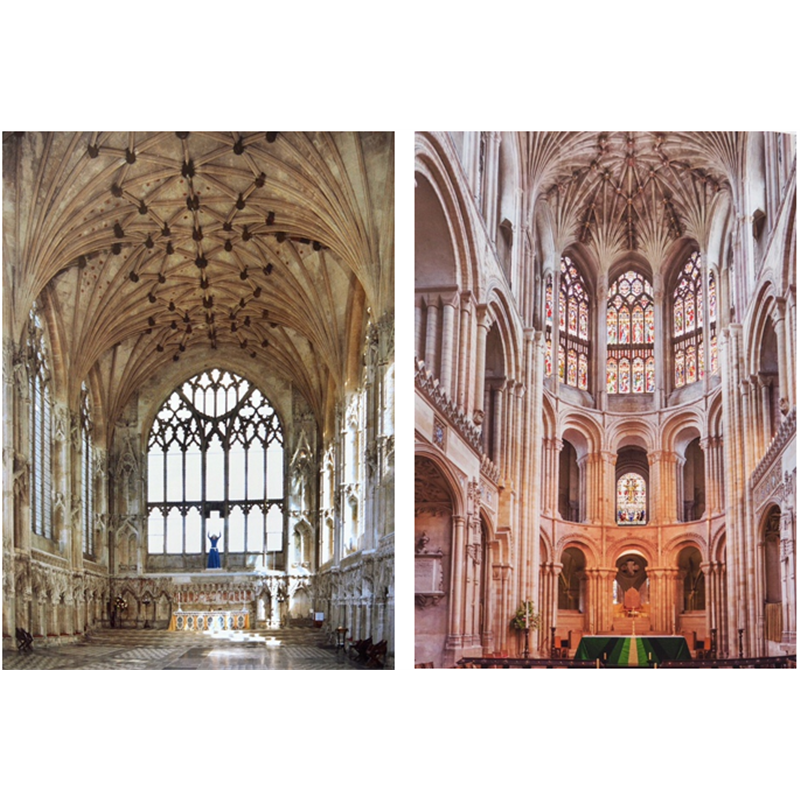
I am a very new member of the Society and had met only a couple of the others before the trip. It was a really enjoyable way to get to know everyone. Fun and informative throughout, we were certainly busy but the whole holiday had a very relaxed feel. Being with an interesting group of very friendly and well informed people with different experiences and wide ranging interests made for great company - and always a range of interesting questions for our guides. There was always
free time to view what we visited, to explore what we found of particular interest as smaller groups or as individuals. There was thus a fair degree of flexibility for everyone. This was possible because the trip was well structured, with specialist guides, a great coach driver and Joe keeping us on message as need be! The hotel was well chosen with comfortable rooms, good food and friendly service. We all ate together in our own dining room, which helped us to get to know each
other well. I hope the above gives a flavour of why our trip was a great shared experience and I certainly look forward to going on another one. |
|
|
| Tuesday, 17 November 2020 |
| CHRISTMAS CONCERT
5.30PM WEDNESDAY 16TH DECEMBER 2020 |
 |
Traditional carols and readings –
plus the unique Brandenburg recipe
for mulled wine!
The Brandenburg Choral Festival is presenting an online
Christmas Concert in association with The Arts Society GLA.
Most of us could do with a little cheering up at the moment!
The pre-recorded musical content will include familiar audience carols singing along with the Brandenburg
Camino Choir as well as Christmas-related music and a few more unusual carol settings by the professional
choir of St Bartholomew the Great. Instrumental support will include the organ, piano, harp and trumpet.
The programme will be interspersed with seasonal readings by members of The Arts Society.
Delivery will be via Zoom. (no technical knowledge required – just click on the link supplied)
A pdf programme will be supplied to be printed at home together with tips to enhance the quality of
audio delivery in the home.
In the interval concert-goers can come off mute, mingle, drink a mulled wine (recipe supplied) and
nibble a mince pie. This will take place in small breakout rooms, each hosted by a member of the
Brandenburg Team. We intend to limit numbers in these breakout rooms to about 10 people so that we
create a genuine social event
TICKETS ARE £10.00
Booking couldn’t be simpler – just click here https://www.ticketsource.co.uk/brandenburg-camino/t-agyrmq?ref=GLA
We will create an online-experience that is as near as possible to
the Traditional Brandenburg Christmas Concerts.
WE DO HOPE YOU WILL JOIN US
|
|
|
| Saturday, 03 October 2020 |
| The pianist Jonathan Powell, 2020 winner of the German Record Critics Award, will be giving a live piano recital on SUNDAY 4th OCTOBER at 15.00 UK TIME
|
 |
Th Concert is on YouTube at https://youtu.be/6eMizPcC96E, to which you are invited. If you can't make it at that time, the video will remain online for a few days at least. The programme (detailed programme note below): Ludwig van Beethoven (1770-1827). Piano Sonata no.30 in E. op. 109.
I. Vivace ma non troppo — Adagio espressivo . II. Prestissimo III. Gesangvoll, mit innigster Empfindung
Our 2020 Festival would have featured Beethoven in his 250th anniversary year. The E major sonata op. 109, written in 1820, is the first of the last three sonatas, which remain peaks of the piano repertoire. The gentle opening of the first movement is contrasted by more passionate passages featuring dramatic harmonies. The second movement is a stormy prestissimo in 6/8 time. The final movement is a peaceful theme with six variations, culminating in a fading reprise of the original theme. Frederic Chopin (1820-1849). Polonaise-Fantaisie op. 61.
Completed in 1846, the Polonaise-Fantaisie combines two familiar aspects of Chopin’s style, the dramatic Polonaise and the reflective Nocturne. While witing it, Chopin remarked ‘I’d like to finish something that I don’t yet know what to call’. Rich in themes, passionate in its development, and technically extremely demanding, this work encapsulates Chopin’s unique pianism. Enrique Granados (1857-1916). The Maiden and the Nightingale, op 11 no. 4.
‘Quejas, o la Maja y el Ruiseñor’ is the fourth of Granados’s ‘Goyescas’ op. 11, written in 1911, inspired by the works of Goya. The suite is subtitled ‘Los majos enamorados (The Gallants in Love)’, and in this piece the lament of the young girl and the song of the nightingale can be clearly identified. The piece is said to have inspired the melody of the 1940 popular song ‘"Bésame mucho’. Alexander Scriabin (1872-1915). Sonata no. 5, op 53.
The 5th Sonata is the first of Scriabin’s single-movement sonatas. Exhausted after the completion of his orchestral ‘Poem of Ecstasy’, the composer rallied and wrote the work in six days on December 1907. It is prefaced by the following words (originally in Russian): ‘I call you to life, O mysterious forces! Drowned in the obscure depths of the creative spirit, timid shadows of life, to you I bring audacity!’ This passionate work was described by Sviatoslav Richter as the most difficult piece in the entire piano repertory. |
|
| Thursday, 04 June 2020 |
| New Online Exhibition: Highlights from the William Morris Society’s Collection (1 June – 13 September 2020) |
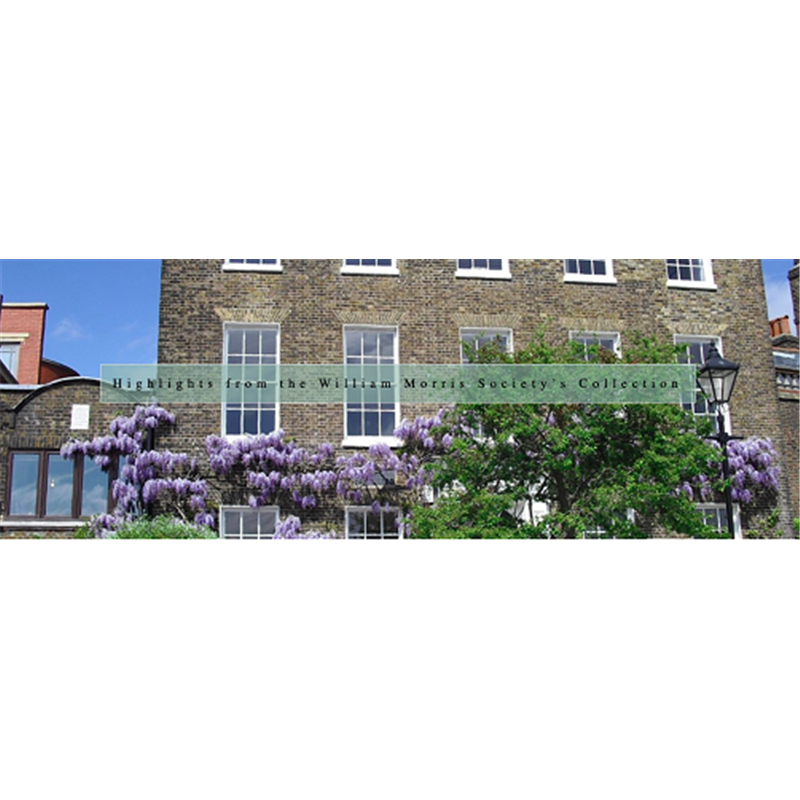 |
Highlights from the William Morris Society’s Collection illustrates the diverse interests that William Morris passionately pursued in his lifetime. Morris had a profound admiration for craftsmanship, utilising and reviving traditional methods of dyeing and printing. Morris’s process of making extended to more than an idea of material craft; he believed that labour itself should be valued and that the learning of manual skills made for a well-rounded life. He believed in the value of good design for the maker as well as the consumer. He was constantly teaching himself different processes and experimenting with new techniques. Morris’s ideas about how we might live and work creatively remain relevant in our own age. This is the William Morris Society’s first online exhibition and will be regularly updated with a series of blog posts. Follow the LINK |
|
| Tuesday, 02 June 2020 |
| MONTHLY HIGHLIGHTS FROM THE ARTS SOCIETY - June |
 |
Monthly Highlights From The Arts Society - June, follow the LINK |
|
| Friday, 29 May 2020 |
| Tea, Travel and Domestic in Silver, a YouTube Lecture by Peter Le Rossignol |
 |
Tea. Travel and Domestic in Silver, By Peter Le Rossignol To watch the video of the Lecture, follow this LINK |
|
| Wednesday, 20 May 2020 |
| Lectures at home series , Nicola Moorby on An Artist of Note: Turner and the new £20 |
 |
The next film in our Lectures at Home series - An Artist of Note: Turner and the new £20 with Accredited Lecturer, Nicola Moorby - is now available to view at connected.theartssociety.org.
J.M.W. Turner is the first British artist to appear on a banknote. This film discusses the background to the new £20 note and examines how the Bank of England's design represents the various aspects of Turner's life, work and legacy.
Nicola Moorby is an independent art historian specialising in British art of the nineteenth and early twentieth centuries. Formerly a curator at Tate Britain she has curated a number of exhibitions and has published widely on J.M.W. Turner. She is also co-editor and author of How to Paint Like Turner (Tate Publishing, 2010).
After the lecture, join Nicola in a forum discussion to ask your questions:
www.connected.theartssociety.org/forum/arts-at-home/lectures-at-home-nicola-moorby |
|
| Wednesday, 13 May 2020 |
| BECOME AN INSTANT EXPERT ON FAKES AND FORGERIES |
 |
From the Arts Society, their latest in the "Become an Instant Expert On ........" Series is now available Become an Instant expert on street Fakes and Forgeries Marc Allum has worked in the world of Art and Antiques for over 30 years, so it is not surprising that he’s encountered a few fakes in his time. Here he uses his insider knowledge to give you five historic and practical pointers on the topic. Click on the link to read more https://theartssociety.org/arts-news-features/become-instant-expert-fakes-and-forgeries |
|
| Tuesday, 05 May 2020 |
| Great Houses of Norfolk - Postponed to 2021 |
 |
More details for this Tour in the Visit section The tour dates are from Tuesday 05 May 2020 to Saturday 09 May 2020. Full brochure and booking form will be available at our July 2019 meeting. You can at present add your name to a list to register your interest. The tour is going ahead. A deposit of £200.00 per person is due as soon as possible and no later than Friday 01 November 2019. |
|
| Tuesday, 28 April 2020 |
| BECOME AN INSTANT EXPERT ON STREET AND ART GRAFFITI |
 |
From the Arts Society, their lastest in the "Become an Instant Expert On ........" Series is now available Become an Instant expert on street Art and Graffiti It’s free, there are no rules and one of its numbers, says Arts Society Lecturer Doug Gillen, is the world’s greatest living artist. Here are his five top facts on the art of graffiti. Click on the link to read more https://theartssociety.org/arts-news-features/become-instant-expert-street-and-art-graffiti |
|
| Thursday, 16 April 2020 |
| Become an Instant Expert |
 |
From the Arts Society, their lastest in the "Become an Instant Expert On ........" Series is now available BY ARTS SOCIETY LECTURER PAUL RABBITTS
One of the greatest ‘inventions’ of the 19th century was the public park – and in current times, they’ve become more important to us than ever before. But what do we actually know about them? Our expert, Arts Society Lecturer Paul Rabbitts, shares his knowledge. For this and all the others in the series please follow this link https://theartssociety.org/arts-news-features |
|
| Tuesday, 30 April 2019 |
| Shropshire and Borders Tuesday 30 April - Saturday 04 May 2019 |
 |
For details consult the Tours area. |
|
| Thursday, 26 April 2018 |
| Normandy Visit 26-30 April 2018
Chateaux, Parks and Gardens |
 |
Visit, Caen , Rouen and Jumieges Abbey. see Tours and Visit section for more details. Booking forms available from Joe Trickey. email josephtrickey@yahoo.co.uk |
|
| Thursday, 08 March 2018 |
| 2018 Annual General Meeting 10.15 a.m. |
 |
|
|
| Thursday, 14 December 2017 |
| Special Interest Day: Fraudulence, Trickery and Deception - Looking into Paintings - by Frank Woodgate |
 |
This Study Day will consist of 2 lectures followed by lunch. For more details look at the Special Interest section. |
|
| Thursday, 05 October 2017 |
| Annual Social Lunch combined with visit to Strawberry Hill House |
 |
For more details see the Visit and Special sections. |
|
| Thursday, 10 August 2017 |
| Special Interest Day: Paintings inspired by Music and Music inspired by Paintings - by Peter Medhurst |
 |
|
|
| Thursday, 09 March 2017 |
| 2017 ANNUAL GENERAL MEETING 10.15 AM |
 |
The AGM will be follwed by the lecture on Gustave Klimt by Frank Woodgate. Ploughman lunch after the lecture. Please purchase a ticket if you wish to take part. |
|
| Thursday, 08 December 2016 |
| Special Interest Day Two: From Magic Lanterns to Metro Goldwyn Mayer - by Dr Geri Parlby |
 |
This day follows the same pattern of three lectures as Special Interest Day One. For more information click on Special Interest section. |
|
| Thursday, 11 August 2016 |
| Special Interest Day One: Layers of Rome - by Dan Evans |
 |
We have two "Special Interest Days" every year and they are held in August and December. The format of these days is slighlty different from our normal monthly meetings as we have three one-hour lectures on a given subject between 10 am and 3 pm, interspersed with breaks for coffee and lunch (with sandwiches and wine). These days give us an excellent opportunity for socialising (as well as learning!) and they are held at our usual venue All Saints Church hall in Sanderstead. For more information about the lectures click on the Special Interest section. |
|
| Wednesday, 25 November 2015 |
| Glyndebourne Visit Review |
 |
Roger and Jill Crowther sent us this review: Our November visit to Glyndebourne in Sussex was a delightful day. We arrived to a warm welcome and our able tour leader, Carla gave us an introduction in the Organ Room where the whole concept of Glyndebourne started. We progressed through the beautifully well planned theatre, viewing the auditorium from on-stage, visiting the large rehearsal rooms and well appointed dressing rooms. From the covered balcony outside the upper circle we were able to view the extensive grounds where summer opera- goers could enjoy their champagne picnics. Our tour finished in the Green Room with a display of elaborate costumes used in recent productions. We lunched in Lewes, many of us at Bill's restaurant, and then individually explored the town. It was a well balanced throroughly enjoyable day and we will remember the magic of Glyndebourne - next summer as opera goers maybe. |
|
| Monday, 05 October 2015 |
| Review of Summer 2015 lectures and trips |
 |
Many thanks to Diana Chitty who has sent us the following review: On August 13 we enjoyed a special interest day on Lee Miller and Roland Penrose, the lectures given by their son Antony. On September 22, on a very wet day, we went to visit Farley Farmhouse in East Sussex where they had lived for 35 years. We had an extremely interesting tour of the house which shows examples of their works together with contemporary art treasures by Picasso, Man Ray, Ernst, Eluard and Miro. Unfortunately it was too wet to visit the scuplture garden. We then went to Tunbridge Wells and had time to have lunch and a look round the Pantiles before returning to Sanderstead. We would like to thank Anne Bennett and Irene Harlow for arranging two such interesting and instructive days. |
|
| Thursday, 02 July 2015 |
| 2015 ANNUAL LUNCH |
 |
‘The Château’, Coombe Lane, Croydon |
|